


If you run a business in Sri Lanka, you have probably heard two different VAT stories this year, and there is a fair chance they have blurred into one in your head. That is understandable. They arrived close together, both had July dates attached, and both got moved.
Here is the short version. One of them is gone. The other is happening on 1 October, and it is not something your accountant can fix for you. It lives inside your billing software.
The Rs. 36 million threshold is not coming
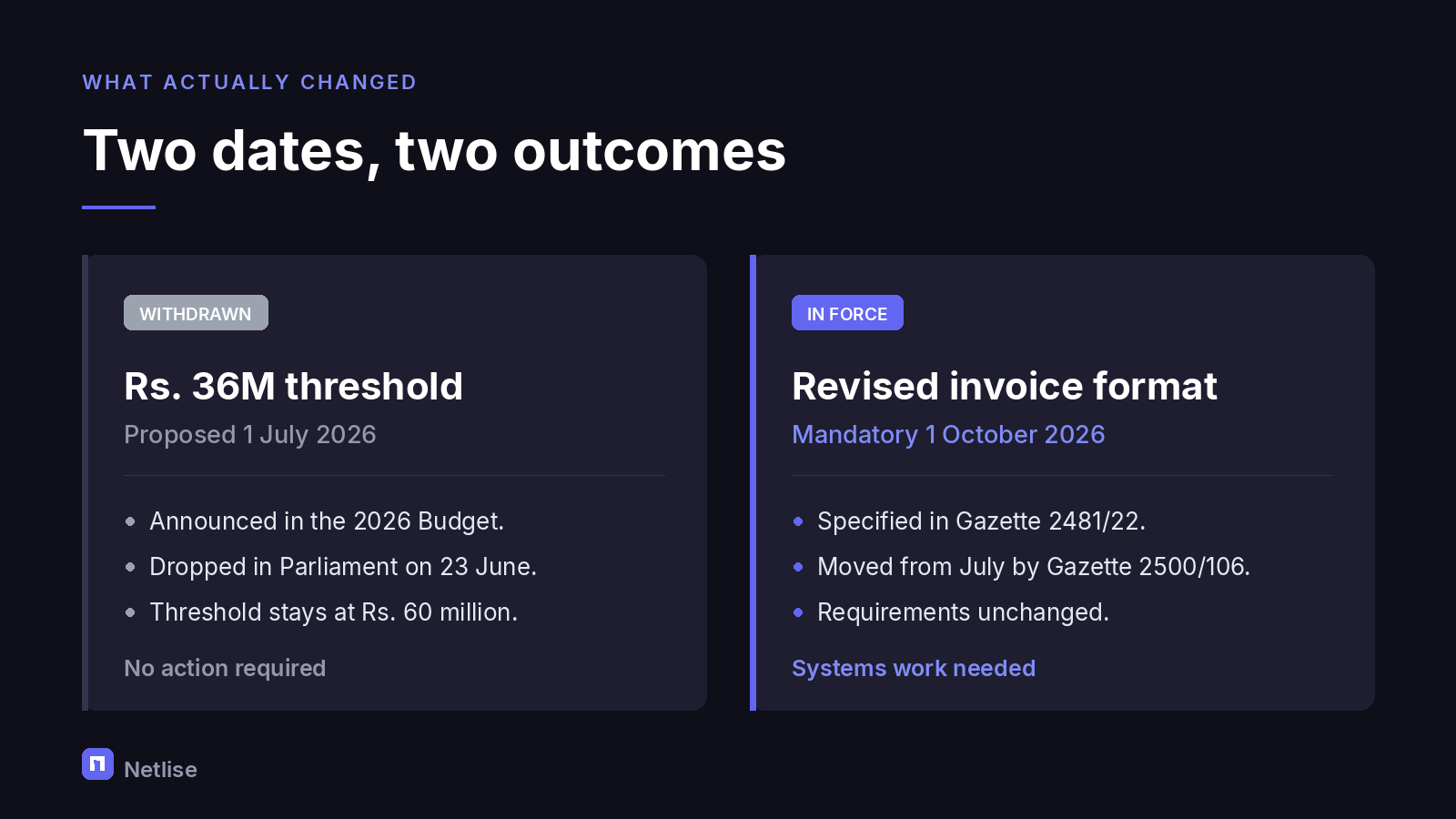
The 2026 Budget proposed dropping the mandatory VAT and SSCL registration threshold from Rs. 60 million a year to Rs. 36 million, with a quarterly figure of Rs. 9 million. It went into the Value Added Tax (Amendment) Bill gazetted at the end of April, due to start on 1 July.
Then it was withdrawn. On 23 June the Deputy Minister of Economic Development told Parliament that the reduction would not go ahead, pointing to the pressure small and medium businesses are still under. The Act the Speaker certified on 30 June left the threshold where it was.
So if you turn over somewhere between Rs. 36 million and Rs. 60 million, nothing has changed for you. You are not required to register on the back of that proposal. Voluntary registration is still an option, and it can be worth it if you want input tax credits or if your customers are registered and would rather claim theirs. But it is a choice now, not an obligation.
If you spent March and April getting ready for registration, that work is not wasted. It is just no longer urgent.
The invoice format is the one that stuck
This is the deadline people keep missing, because it sounds like paperwork and it is actually a software project.
The Commissioner General of Inland Revenue set out a standardised tax invoice format in Gazette Extraordinary No. 2481/22, dated 27 March 2026, under section 20 of the VAT Act. It was meant to start on 1 July. Businesses said they needed longer to update their accounting and invoicing systems, and the Department agreed. Gazette Extraordinary No. 2500/106 pushed mandatory adoption to 1 October 2026.
What it did not do is soften any of the requirements. Only the date moved. From 1 October, every VAT registered person issuing a tax invoice is expected to comply.
What the specification asks for
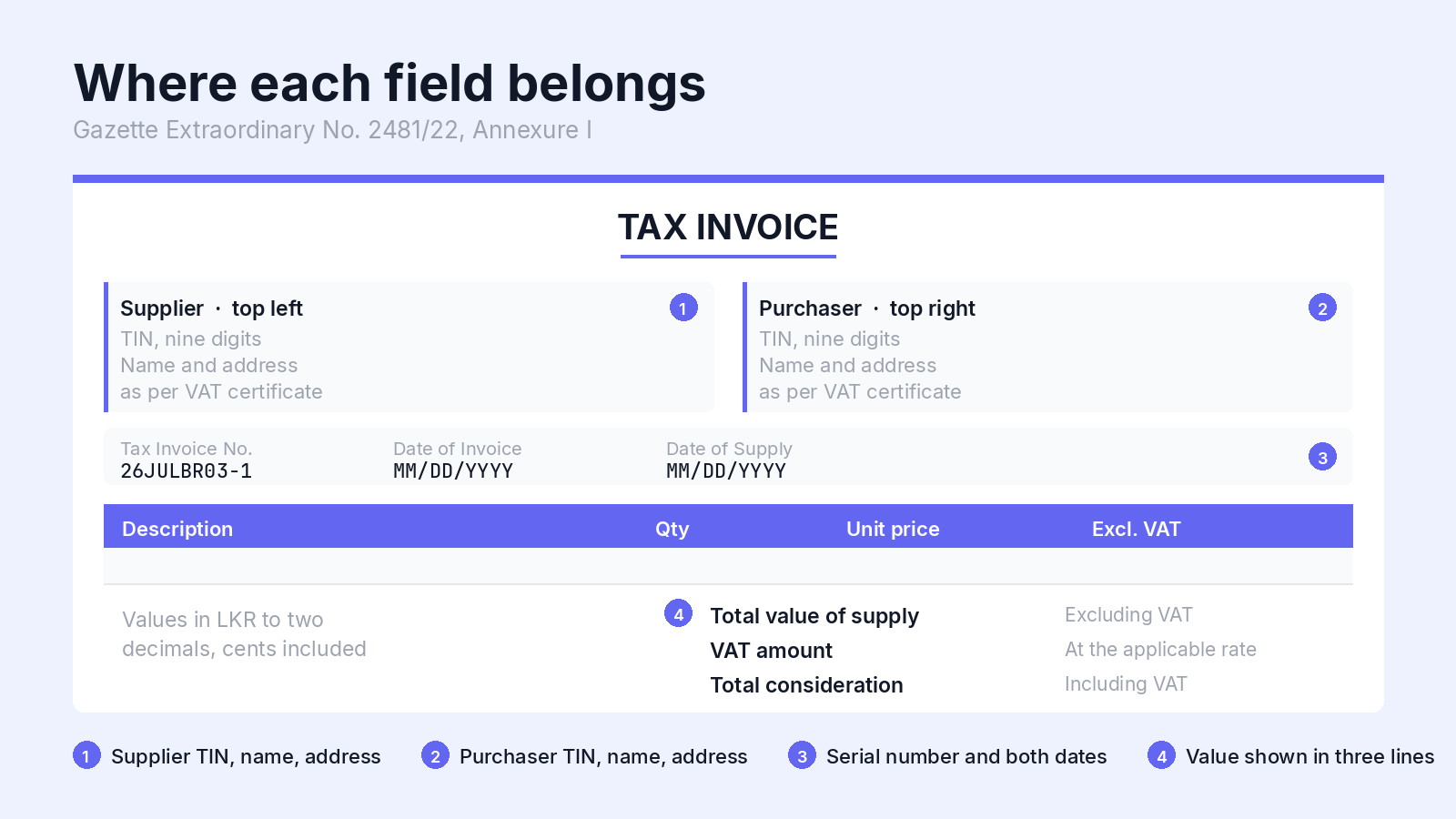
Plenty of it is straightforward. The document has to be clearly titled "TAX INVOICE" in bold or highlighted text, somewhere obvious on the face of the invoice. Supplier details sit in the top left: the nine digit Taxpayer Identification Number, name and address, exactly as they appear on your VAT registration certificate. Purchaser details go top right, or directly underneath the supplier block, with the purchaser's TIN. Phone numbers are optional on both sides.
Then there is the invoice serial number, which is where most systems will fall over.
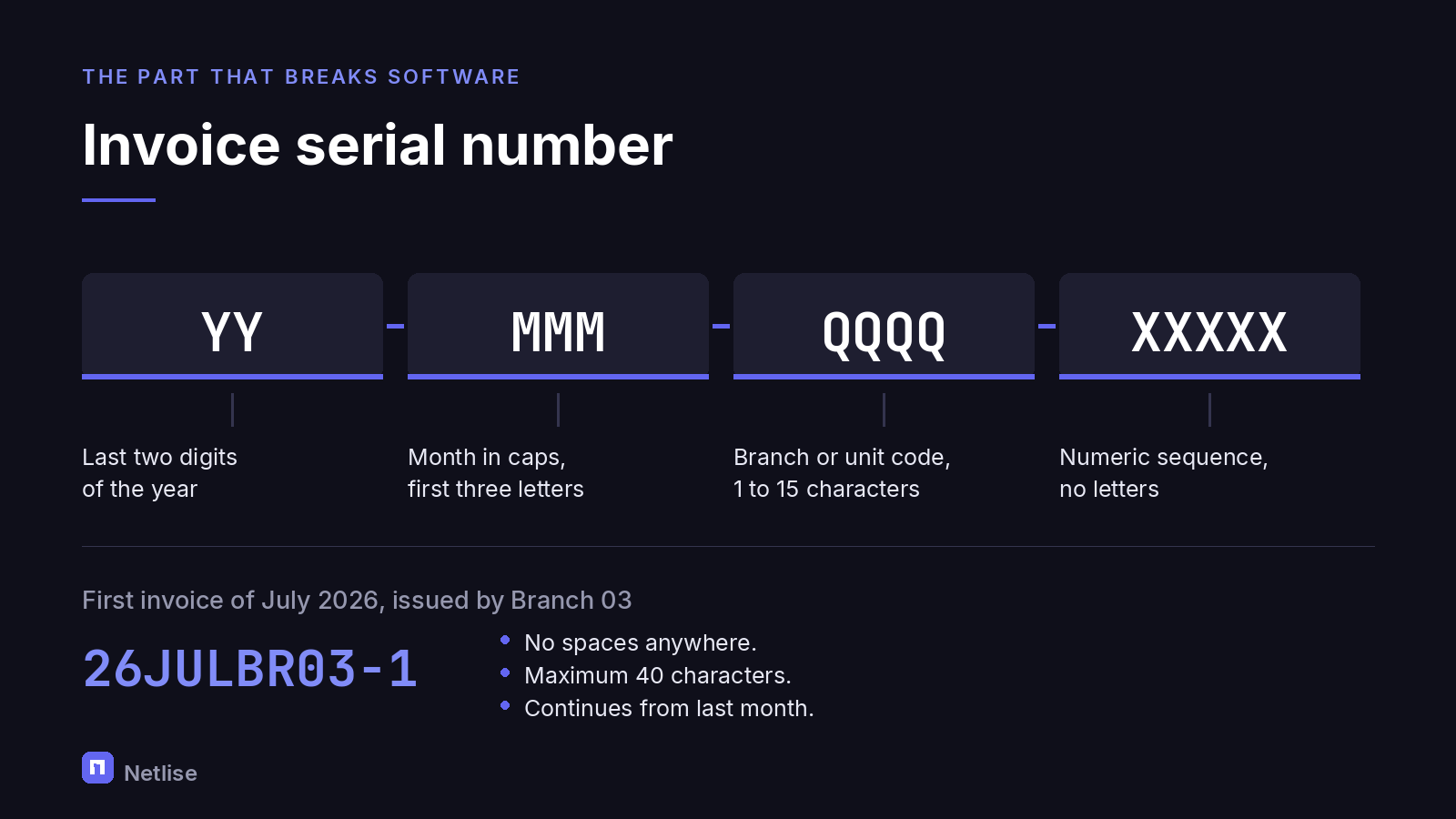
The required structure is YYMMM_QQQQ_XXXXX. YY is the last two digits of the year. MMM is the first three letters of the month in capitals. QQQQ is a code of your own choosing, between one and fifteen characters, identifying a branch, section, unit, project, customer or whatever classification suits you. XXXXX is a purely numeric sequence, no letters and no symbols. The whole thing carries no spaces and stays under forty characters. The number continues from wherever last month ended, though you may restart it monthly or annually if you need to. The gazette gives a worked example: the first invoice issued in July 2026 by Branch 03 as 26JULBR03-1.
Read that again with your own system in mind. If it currently spits out a plain running number, or writes the year in four digits, or allows a letter anywhere in the sequence, that is development work. It is not a settings screen.
Two more things worth checking carefully. Both the invoice date and the supply date must be written MM/DD/YYYY, which flips the day and month order most Sri Lankan systems default to. The nasty part is that the mistake is invisible for the first twelve days of any month, so it will pass a casual test and fail an audit. And values are stated in rupees to two decimal places with cents included, showing the value excluding VAT, the VAT charged, and the total including VAT as three separate lines. Stating the total in words is optional, as are the place of supply and mode of payment.
One requirement that catches retailers and distributors: a tax invoice may only contain goods or services subject to VAT. If a single sale mixes taxable and exempt items, your document structure has to deal with that.
You do get room to breathe on presentation. Logos and trademarks are fine in the header or footer, you can add columns and rows, and the specimen layout in the gazette is a guide rather than a straitjacket.
Where to start, realistically
Begin by finding out what your invoices actually look like right now, across everything that issues one. This sounds obvious and it is where most businesses get their first surprise. A shop with a POS terminal, an accounting package in the back office and a Word template for corporate customers usually has three formats in circulation, and someone has only ever checked one of them.
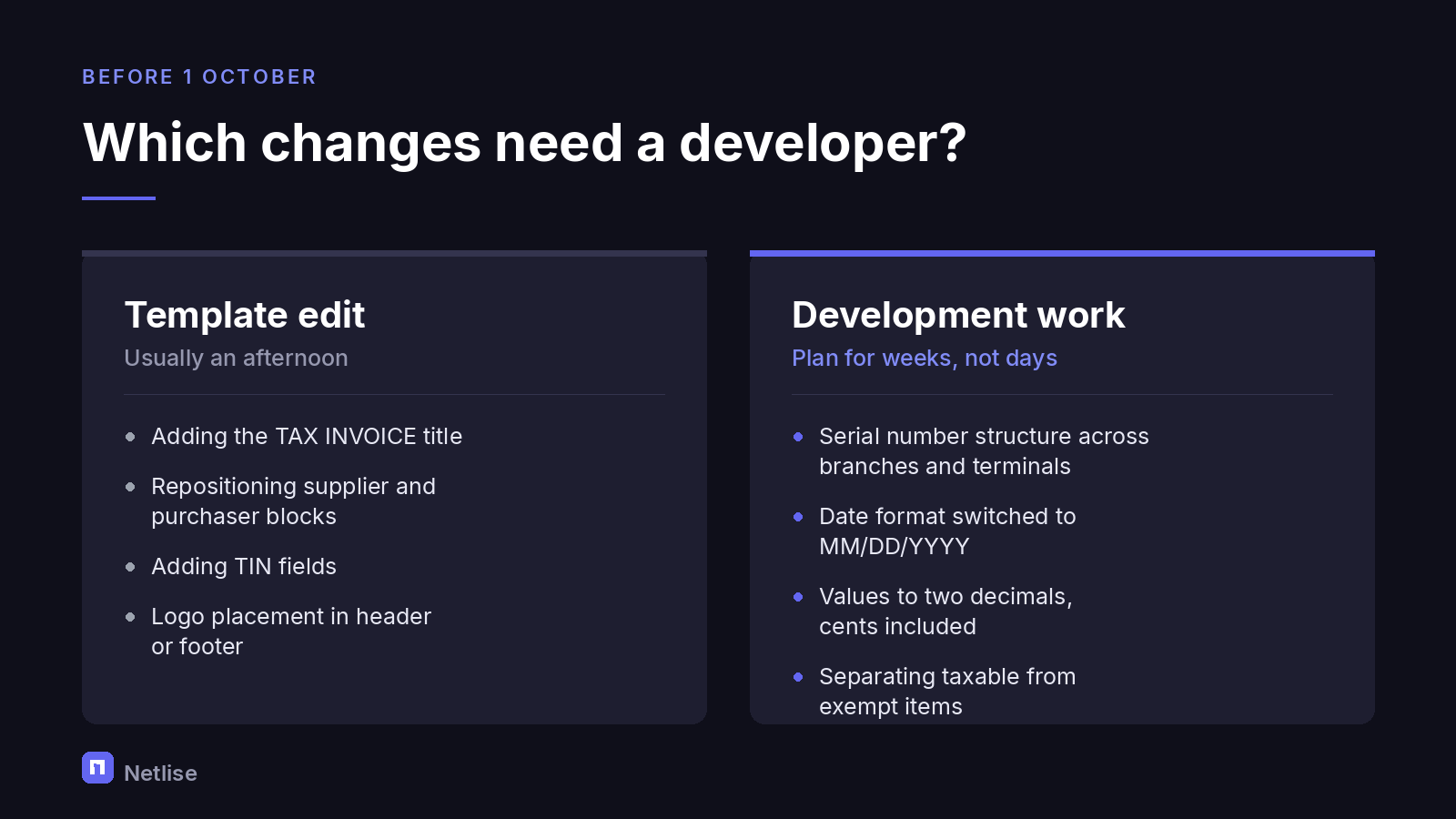
Next, sort the changes into two piles. Adding a title or moving an address block is a template edit. Rebuilding how serial numbers are generated, especially across multiple branches or terminals that must never produce the same number twice, is not. If a vendor supplies your software, ask them today whether a compliant version exists and when it ships. Their queue in the second half of September will be considerably longer than it is this week.
Then test properly, with real data, before the deadline rather than after it. Print a sample invoice, sit down with whoever handles your VAT returns, and go through the gazette clause by clause. It is a short document and the whole exercise takes about an hour.
Finally, run your reading past your tax advisor. There are transitional questions worth settling with someone who knows your situation, particularly around invoices that straddle the changeover and the status of the earlier November 2025 specification.
Why this is worth doing properly
It is tempting to treat October as a formatting chore, get the template looking right and move on. That works until the next round.
Standardised, structured invoice data is the groundwork for electronic invoicing and for the digital tax administration the Department has been signalling for a while now. Businesses that solve this with a cosmetic patch will be back in the same systems before long. Businesses that use it as a reason to get clean, reliable transaction data flowing out of their billing systems will find whatever comes next far less painful.
The date is set and the specification is published. The only thing still up for grabs is how much of September you want to spend on it.
General information, current as at 20 August 2026. This is not tax or legal advice. Check your own position with a qualified advisor and refer to the gazette notifications and Inland Revenue Department publications for the authoritative requirements.